
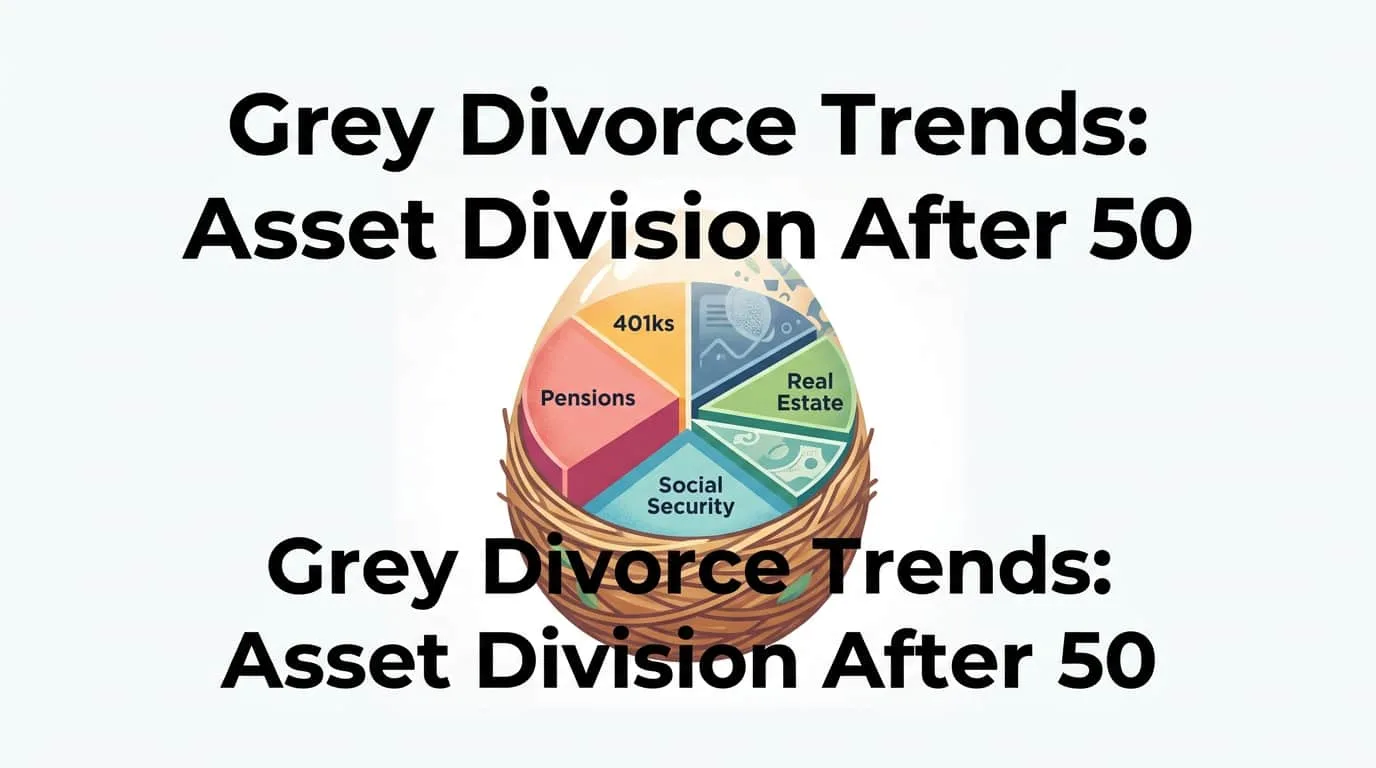
Divorcing after 50 looks very different from divorcing at 30. The financial stakes are higher, the assets are more complex, and the timeline for recovery is shorter. For couples in the Altamonte Springs area who have spent decades building wealth together, understanding how Florida law handles asset division is the first step toward protecting your financial future.
If you are considering a later-life divorce and need guidance specific to your situation, Frank Family Law Practice is ready to help. Call (407) 629-2208 to schedule a consultation.
What Is a Grey Divorce—and Why Is It So Financially Complicated?
A "grey divorce" refers to any divorce involving spouses aged 50 or older. The rate of grey divorces in the United States has roughly doubled since the 1990s, even as overall divorce rates have declined. For couples who have been married for 20, 30, or even 40 years, the financial untangling is far more complex than what younger couples typically face. There are pensions to divide, retirement accounts to split, long-term real estate to evaluate, and Social Security benefits to consider—all at a stage of life where rebuilding from a financial misstep is difficult.
The stakes are simply higher. A 35-year-old has three decades to recover from a poorly negotiated divorce settlement. A 58-year-old does not.
How Does Florida's Equitable Distribution Law Apply to Long Marriages?
Florida follows an equitable distribution model, which means marital assets are divided fairly—but not necessarily equally. Courts start from a presumption of a 50/50 split and then consider factors like the length of the marriage, each spouse's financial contributions, and any intentional waste or dissipation of marital assets.
For long-term marriages, this matters in a specific way: virtually everything accumulated during the marriage is considered marital property. The family home, investment portfolios, business interests, and retirement accounts built up over decades are all on the table. Separate property—assets owned before the marriage or received as gifts or inheritance—can remain yours, but only if it was never commingled with marital funds. After 30 years of shared finances, proving that a particular asset was always "yours" is often a serious challenge.
What Happens to Retirement Accounts, Pensions, and 401(k) Plans?
This is where grey divorce gets particularly technical. Retirement accounts like 401(k)s and IRAs are generally considered marital property to the extent that contributions were made during the marriage. Dividing them incorrectly can trigger significant tax penalties and fees that permanently reduce their value.
To divide a 401(k) or pension without those penalties, the court issues a Qualified Domestic Relations Order (QDRO). This legal document instructs the plan administrator to transfer a portion of the account to the non-employee spouse. Without a properly drafted QDRO, early withdrawal penalties of 10% can apply—on top of ordinary income taxes. On a $400,000 retirement account, that could mean losing $40,000 or more before either party sees a dollar.
Defined benefit pensions add another layer of complexity. Their value depends on future payouts, retirement age assumptions, and actuarial calculations. Getting an accurate valuation typically requires a financial expert. Couples near Winter Park or Maitland who have accumulated decades of pension benefits often underestimate how much is actually at stake in this single asset alone.
Experienced divorce attorneys who handle grey divorce cases will work alongside financial professionals to ensure these accounts are properly valued and divided in a way that reflects their true long-term worth.
Should You Keep the Family Home or Downsize?
For many couples in the Altamonte Springs area, the family home is the largest single asset in the marriage. Deciding whether to keep it or sell it is one of the most emotionally and financially loaded decisions in a grey divorce.
Keeping the home may feel like stability—but the numbers often tell a different story. Can one spouse realistically carry the mortgage, property taxes, insurance, and maintenance costs alone? If the home has significant equity, keeping it may mean forfeiting your share of retirement accounts in exchange. That trade-off can leave you house-rich and cash-poor at exactly the wrong time.
Selling and downsizing, on the other hand, allows both parties to walk away with liquid assets that can be invested, banked, or used to fund separate living arrangements. Florida's real estate market, particularly in and around Seminole County and Orange County, has seen significant appreciation in recent years. Many long-term homeowners are sitting on substantially more equity than they realize—making the sale option more financially attractive than it might appear on the surface.
A knowledgeable family law practice in Altamonte Springs, Florida can help you assess both paths clearly, rather than letting emotion drive what should be a calculated financial decision.
How Does Grey Divorce Affect Social Security and Healthcare?
Two areas that often catch divorcing spouses over 50 off guard are Social Security benefits and health insurance coverage.
On Social Security: if your marriage lasted at least 10 years, you may be entitled to claim benefits based on your ex-spouse's earnings record—up to 50% of their benefit amount—without reducing what they receive. This can be a significant advantage for a spouse who stepped back from their career to raise children or support the household. However, the 10-year threshold is firm. A marriage that ended at 9 years and 11 months does not qualify.
Healthcare is the more immediate concern. Many spouses over 50 are covered under a partner's employer-sponsored health plan. Divorce ends that coverage. COBRA continuation coverage is available, but it typically costs 100% to 102% of the full premium—often $600 to $900 or more per month for an individual. If you are between 50 and 65 and not yet eligible for Medicare, securing affordable private health insurance needs to be factored into your financial planning from day one, not as an afterthought.
Why Does Specialized Legal and Financial Expertise Matter So Much Here?
Grey divorce is a different category of legal work than a standard dissolution of marriage. The assets involved—QDROs, business valuations, pension analysis, complex real estate holdings—require attorneys who genuinely understand the financial intricacies at play, not just the procedural ones.
This is also where the method of divorce matters. For couples who want to resolve things with less conflict and more control over the outcome, collaborative law offers a structured alternative to courtroom litigation. In the collaborative process, both spouses work with their attorneys and neutral financial and mental health professionals to reach a mutually agreeable settlement. It preserves dignity, often costs less than contested litigation, and keeps sensitive financial details out of the public court record.
For residents throughout the Altamonte Springs, Longwood, and Casselberry communities, having a family law practice in Altamonte Springs, Florida that knows this process inside and out is a genuine asset when the stakes are this high.
Protecting Your Financial Future After 50
A grey divorce does not have to mean financial ruin. With the right legal guidance, a clear-eyed assessment of your assets, and a strategy built for where you are in life—not where you were 25 years ago—you can come through this process with your financial stability intact.
The decisions made in the first weeks of a grey divorce often shape the outcome for decades. Retirement accounts divided without a proper QDRO, homes retained without a realistic budget, or Social Security timing ignored can compound into serious long-term losses.
Frank Family Law Practice serves clients across Central Florida, with deep experience in the complex asset issues that define later-life divorce. Our team at the family law practice in Altamonte Springs, Florida is here to provide clear, honest guidance built around your specific circumstances. Call us today at (407) 629-2208 to schedule your consultation and take the first step toward protecting what you've spent a lifetime building.