
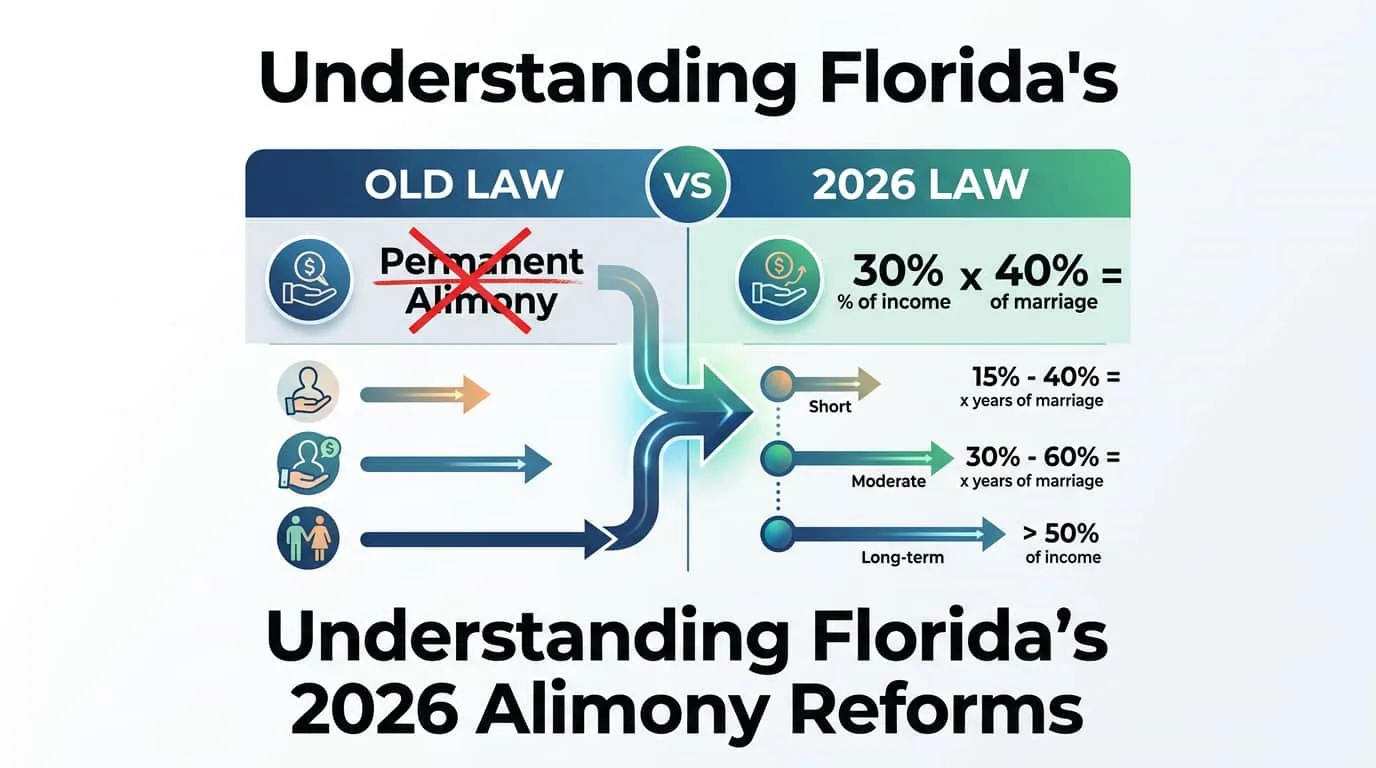
Florida's 2026 alimony reforms are reshaping how courts handle spousal support across the state, and the changes are significant for married residents in Orlando and Winter Park. Permanent periodic alimony is gone. In its place, the new statutes introduce durational and rehabilitative structures with stricter eligibility standards and percentage-based caps. If you're currently in a marriage or going through a divorce in Central Florida, these updates affect you directly.
Need to talk through your situation right now? Call Frank Family Law Practice at (407) 629-2208 to schedule a consultation.
What Changed With Florida's 2026 Alimony Law?
Florida's 2026 reforms eliminate permanent periodic alimony entirely, replacing it with time-limited support structures tied directly to the length of the marriage. Courts now rely on two primary forms: durational alimony, which caps support at a set percentage of the marriage's length, and rehabilitative alimony, which funds a specific plan for the receiving spouse to gain financial independence.
This is one of the most significant shifts in Florida family law in decades. For years, long-term marriages in Orange County could result in indefinite alimony orders with no clear end date. That's no longer the case.
How Does Marriage Length Affect Eligibility Under the New Rules?
Under the 2026 statutes, Florida courts classify marriages into three categories, and eligibility for alimony type and duration depends on which category applies.
- Short-term marriages (fewer than 7 years): Durational alimony may be awarded for up to 50% of the length of the marriage.
- Moderate-term marriages (7 to 16 years): Support may extend up to 60% of the marriage's duration.
- Long-term marriages (17 years or more): Courts may award durational alimony for up to 75% of the marriage length.
The amount itself is capped at 35% of the difference between the spouses' net incomes. So if one spouse earns $8,000 per month net and the other earns $3,000, the maximum monthly support is $1,750. That's a firm ceiling, regardless of lifestyle claims or prior agreements in some cases.
Judges still retain discretion in exceptional circumstances, but the percentage-based framework makes outcomes far more predictable than before. For families near Winter Park's historic neighborhoods or in the newer developments off Interstate 4 near Altamonte Springs, that predictability matters when planning finances post-divorce.
What Is the "Retirement Rule" and Does It Apply to Existing Orders?
Under the 2026 reforms, a payor who reaches full retirement age, as defined by the Social Security Administration (currently 67 for those born after 1960), can petition the court to reduce or terminate alimony. This is now a recognized rebuttable presumption in Florida, meaning the burden shifts to the receiving spouse to show why payments should continue.
For existing alimony orders entered before the 2026 statute, modification is possible but not automatic. The paying spouse must file a petition showing a substantial change in circumstances. Reaching retirement age qualifies, but courts will evaluate the receiving spouse's financial needs, health, and ability to work.
We handle modification cases regularly out of our family law practice in Altamonte Springs, Florida, and the retirement question comes up more than people expect, especially for couples who divorced years ago under the old permanent alimony standard.
How Are Families in Central Florida Dealing With These Changes?
Divorce is rarely just a legal matter. For families in Orlando's College Park neighborhood or those living near Lake Lilly in Maitland, the financial ripple effects of an alimony order touch every aspect of daily life: housing decisions, retirement savings, college planning for children.
The elimination of permanent alimony is good news for many payors who felt locked into indefinite obligations. For recipients, especially those who left careers to support a family during a long marriage, the new caps can create real financial pressure. The rehabilitative alimony option is designed to bridge that gap, but it requires a specific, court-approved plan with defined goals and a timeline.
Courts in Orange and Seminole Counties are still developing consistent approaches to these new standards, which means outcomes can vary significantly depending on the circuit and the judge assigned. Having experienced legal counsel in your corner isn't optional. It's a practical necessity.
If you're going through a divorce and want to understand your options, our divorce attorney team can walk you through what the 2026 rules mean for your specific situation.
What Should You Do If You're Currently Mid-Divorce or Seeking a Modification?
If your divorce is already filed or you're seeking a modification of an existing order, the 2026 changes may apply to your case depending on the timing and procedural status. Here's what to do right now:
- Document your income carefully. Because alimony amounts are now tied to net income calculations, accurate financial disclosure is critical. Errors or omissions can affect the outcome significantly.
- Request a rehabilitative alimony plan if you're the recipient. Courts won't craft this plan for you. You or your attorney need to present a credible roadmap, whether that means completing a degree, getting a professional certification, or re-entering a prior career.
- File promptly if you're seeking retirement-based modification. Waiting too long can result in overpayments that courts are reluctant to retroactively correct.
- Consider collaborative law as an alternative. Rather than letting a judge decide under the new statutory framework, couples who can negotiate directly often reach outcomes that work better for both parties. Our collaborative law process gives both spouses control over the result.
Our family law practice in Altamonte Springs, Florida works with clients across Orange and Seminole Counties, and we've seen firsthand how the transition to the new law creates confusion for people who thought they understood their rights under prior agreements.
Why Local Legal Expertise Makes All the Difference
Florida's alimony reform law isn't complicated in the abstract. But applying it to a real marriage, with real assets, real income differences, and real children, requires a lawyer who knows how Central Florida circuit courts interpret these statutes in practice.
The judges in Orange County aren't handling these cases the same way courts in Miami-Dade or Hillsborough are. Local experience is a real advantage, not just a marketing point. Frank Family Law Practice has been serving Orlando, Winter Park, and Altamonte Springs for years with a team that's focused entirely on family law. No criminal defense, no personal injury. Just family law.
Jennifer Frank, the firm's managing partner and owner, is Board Certified in Marital and Family Law by the Florida Bar. That distinction puts her among a small percentage of attorneys in the state who have met the Florida Bar's rigorous standards for expertise in this specific area.
Talk to a Local Attorney Before Making Any Decisions
The 2026 alimony reforms create real opportunities for some and real challenges for others. Sorting out which side of that equation you're on requires an honest look at your income, your marriage length, your spouse's financial situation, and what a realistic alimony order would look like under the new caps.
Don't make assumptions based on what you've read online or what a friend told you about their divorce. Every case is different, and the stakes are too high to guess.
Contact Frank Family Law Practice at (407) 629-2208 today to schedule your consultation. Our team is ready to answer your questions clearly and give you an honest picture of where you stand under the new law.