
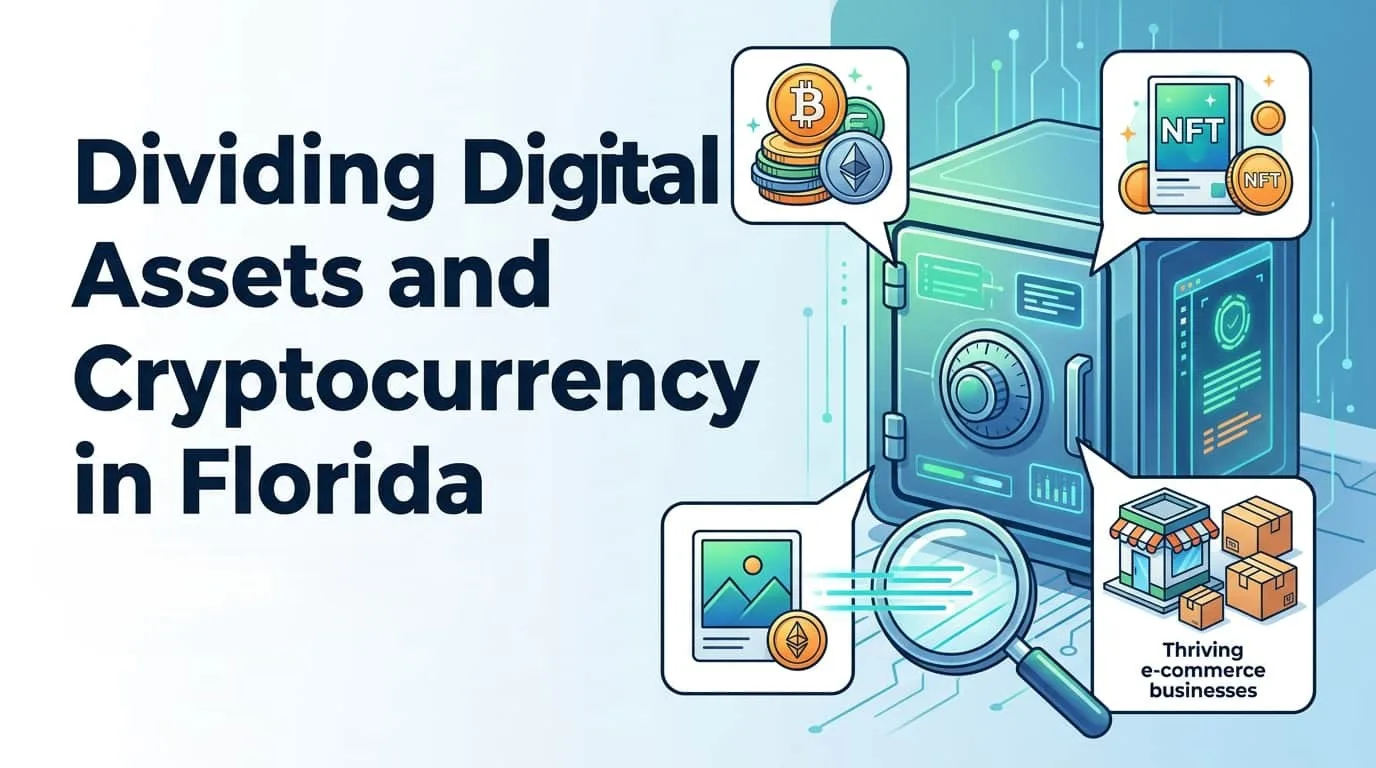
Dividing Bitcoin, NFTs, and digital wallets in a Florida divorce is one of the most technically demanding challenges in family law today. Orlando and Winter Park couples who hold cryptocurrency face a layer of legal complexity that traditional asset division simply doesn't account for. If your marriage involves significant digital holdings, you need an attorney who understands both the law and the technology.
Frank Family Law Practice handles complex asset division cases across Central Florida, including those involving cryptocurrency portfolios. Call (407) 629-2208 to schedule a consultation.
How Does Florida Law Handle Cryptocurrency in a Divorce?
Under Florida Statute 61.075, all marital assets are subject to equitable distribution, and cryptocurrency is no exception. Bitcoin, Ethereum, NFTs, and digital wallets acquired during the marriage are treated as marital property, regardless of which spouse held the private key. Florida courts don't split assets 50/50 by default. Instead, judges weigh factors like each spouse's financial contribution, the length of the marriage, and economic circumstances to reach a fair division.
Crypto purchased before the wedding may qualify as separate property, but only if it stayed completely separate from marital funds. Mixing pre-marital holdings with joint money, even once, can make the entire portfolio subject to equitable distribution. In our experience handling complex asset cases throughout the Winter Park and Orlando area, this commingling issue comes up far more often than most couples expect.
What Makes Cryptocurrency So Difficult to Value During Discovery?
Valuing crypto during a Florida divorce is complicated by two things: extreme price volatility and the pseudonymous nature of blockchain transactions. A Bitcoin wallet worth $80,000 in January could be worth $55,000 by the time your case reaches trial. Courts typically use the fair market value on the date of distribution, but your attorney needs to document valuations carefully throughout the process.
Discovery is the other major hurdle. A spouse who wants to hide digital assets can create multiple wallets, transfer holdings to cold storage devices, or move funds to decentralized exchanges with no centralized record-keeping. Without a forensic accountant, those assets can disappear from the marital estate entirely.
What Role Does a Forensic Accountant Play in Tracing Hidden Blockchain Assets?
A forensic accountant with blockchain experience can trace transactions across public ledgers, identify wallet addresses linked to a spouse, and reconstruct a complete picture of digital asset activity during the marriage. Every Bitcoin transaction is permanently recorded on the blockchain. That's a paper trail no one can delete.
Forensic accounting services in Florida divorce cases typically run between $3,000 and $10,000, depending on the complexity of the portfolio and how many exchanges or wallets are involved. For couples in neighborhoods like Dr. Phillips or Winter Park's Rollins College corridor, where high-income households are common, that investment often protects far more in recovered assets than it costs. The family law practice Winter Park Florida community has seen a significant rise in crypto-related asset disputes over the past three years, and forensic tracing has become a standard tool in contested cases.
What Are the Tax Consequences When Crypto Gets Divided in a Divorce?
The IRS classifies cryptocurrency as property, which means transfers between spouses incident to divorce are generally not taxable at the time of transfer. However, capital gains taxes become a major issue when the receiving spouse later sells those assets.
Here's why this matters: a Bitcoin purchased at $10,000 that's now worth $60,000 carries $50,000 in embedded capital gains. If one spouse receives the appreciated portfolio while the other receives cash or real estate of equivalent value, the outcome isn't truly equal after taxes. A forensic accountant or CPA should calculate the after-tax value of each asset before your attorney negotiates the split. Ignoring this step can cost tens of thousands of dollars in unexpected tax liability within 12 to 24 months of the divorce being finalized.
What Should a Marital Settlement Agreement Say About Digital Wallets?
A standard marital settlement agreement wasn't designed with crypto in mind. Vague language like "all digital accounts" won't hold up when a spouse claims a hardware wallet falls outside the agreement's scope.
Your MSA should specify:
- The exact wallet addresses being transferred
- The specific coin types and quantities as of a defined valuation date
- Whether the transfer is to be completed on-chain or through an exchange
- A deadline for transfer, typically 30 to 60 days from the date the agreement is signed
- What happens if the value changes between signing and transfer
Working with a divorce attorney who has handled digital asset cases is the difference between an agreement that protects you and one that creates years of post-divorce litigation.
How Do You Actually Transfer Crypto After a Divorce Is Finalized?
The mechanics of transferring digital assets post-divorce are often overlooked until the last minute. Unlike a bank account, there's no customer service line to call. The transfer requires the transferring spouse to share a private key or initiate an on-chain transfer to a wallet address controlled by the receiving spouse.
This creates real security risks. Sharing a private key gives temporary access to the entire wallet. The receiving spouse should set up a new, independent wallet before the transfer, and the transfer should be completed in a single, documented transaction. Both spouses should retain records of the transaction hash, which serves as proof of completion on the blockchain.
Some couples going through collaborative law proceedings find it easier to agree on a neutral third-party custodian to handle the transfer, which removes the need for either spouse to share sensitive security credentials directly. Given how often disputes arise in this final step, building a clear transfer protocol into your settlement agreement from the start saves significant headaches.
Why Does Working with a Local Florida Divorce Expert Matter for Tech Assets?
Florida's equitable distribution law, combined with federal tax rules and blockchain technology, creates a situation where general legal advice simply isn't enough. A family law practice Winter Park Florida couples rely on for complex asset cases needs to understand all three layers simultaneously.
We've handled cases across the greater Orlando area, from Downtown to Winter Park to Altamonte Springs, where cryptocurrency made up a substantial portion of the marital estate. The attorneys at Frank Family Law Practice know how local courts approach digital asset valuation, which forensic experts produce reliable blockchain reports, and how to draft settlement language that holds up long after the divorce is finalized.
This is also an area where the difference between an experienced local firm and a general practice attorney shows up quickly. Courts in Orange County treat crypto as they would any other high-value asset: they expect precise documentation, credible valuation methodology, and clear transfer instructions. A family law practice Winter Park Florida residents trust for these cases will know exactly what judges in this jurisdiction expect to see.
Get the Right Help for Your Digital Asset Divorce
Crypto divorces are one of the most technically demanding areas of Florida family law. Getting the valuation wrong, missing hidden wallets, or drafting vague settlement language can cost you far more than the legal fees you're trying to avoid.
If your marriage involves Bitcoin, Ethereum, NFTs, or any other digital assets, don't handle the division without experienced legal support. Contact Frank Family Law Practice at (407) 629-2208 to speak with a Florida family law attorney who understands the full complexity of digital asset division.